
Chatbot Lead Generation: How AI Bots Capture and Qualify Leads 24/7
Learn how chatbot lead generation works, best practices, real ROI stats, and how to deploy your own AI lead gen bot in 60 seconds. Complete 2026 guide.

Jean-Elie Lecuy
|Founder of ClawRapid
SaaS builder writing about OpenClaw, AI agents, and agentic coding, with one goal: make powerful tooling actually usable.
Every business needs leads. But traditional lead capture -- static forms, gated PDFs, "leave your email" pop-ups -- is broken. The average website conversion rate sits at just 3.3%. That means 96 out of 100 visitors leave without a trace.
Chatbot lead generation flips this equation. Instead of waiting for visitors to fill out a form, an AI chatbot starts a conversation, qualifies prospects in real time, and captures contact information naturally. Companies using lead generation chatbots report conversion rates of 15-40% -- a 5x to 12x improvement over static forms.
In this guide, you will learn exactly how chatbot lead generation works, the best practices top companies follow, real ROI numbers, and how to deploy your own lead gen chatbot in under 60 seconds.
Table of Contents
- What Is Chatbot Lead Generation?
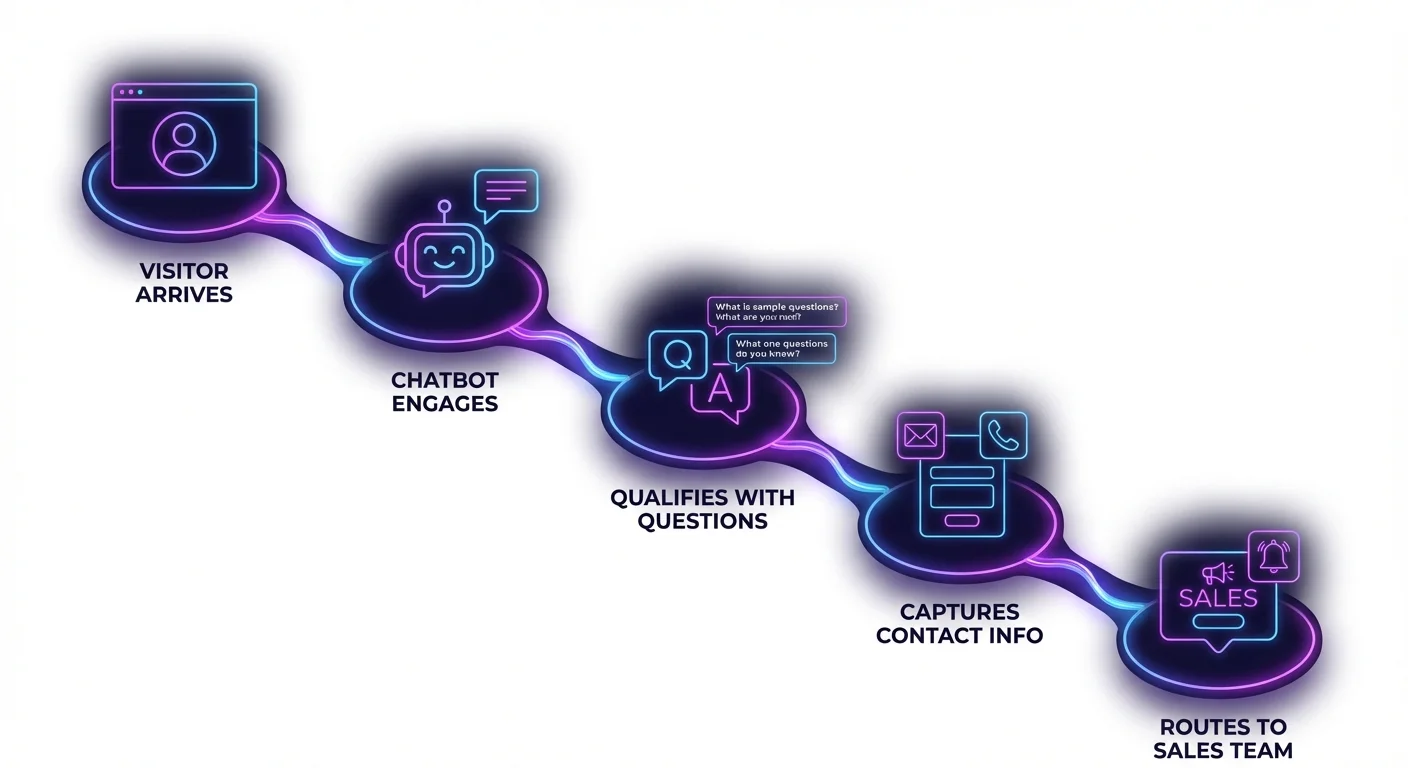
- How Chatbots Generate Leads: The 4-Step Process
- Why Chatbots Outperform Traditional Lead Forms
- 7 Best Practices for Lead Generation Chatbots
- Chatbot Lead Generation ROI: Real Numbers
- Types of Lead Generation Chatbots
- Best Channels for Chatbot Lead Generation
- How to Set Up a Lead Generation Chatbot in 60 Seconds
- Common Mistakes to Avoid
- FAQ
- Bottom Line
What Is Chatbot Lead Generation?
Chatbot lead generation is the process of using automated conversational bots to identify, engage, qualify, and capture potential customers. Instead of presenting a static form and hoping visitors fill it out, a lead generation chatbot initiates a two-way conversation that feels natural and helpful.
A lead gen chatbot can:
- Greet visitors proactively based on their behavior (time on page, scroll depth, referral source)
- Ask qualifying questions to determine if the visitor is a good fit
- Collect contact information (email, phone, company) conversationally
- Route hot leads to your sales team instantly
- Nurture cold leads with helpful content and follow-ups
The key difference from traditional chatbots? Lead generation chatbots are designed with a specific goal: turning anonymous visitors into identified, qualified prospects in your CRM or sales pipeline.
How Chatbots Generate Leads: The 4-Step Process
Every effective lead generation chatbot follows the same core process. Understanding these four steps will help you design conversations that convert.
Step 1: Engage the Visitor
The chatbot initiates contact at the right moment. This could be:
- A welcome message when someone lands on your pricing page
- A proactive offer after 30 seconds of browsing
- A triggered message when a visitor shows exit intent
- A response to a specific action (clicking a CTA, viewing a product)
The goal is to start a conversation before the visitor bounces. According to Drift's research, 50% of leads go to the vendor that responds first. A chatbot responds in milliseconds.
Step 2: Qualify with Smart Questions
Once engaged, the chatbot asks targeted questions to determine lead quality:
- "What's your biggest challenge with [topic]?"
- "How many people are on your team?"
- "What's your timeline for implementing a solution?"
- "What's your budget range?"
These questions serve a dual purpose: they help you score the lead AND they make the visitor feel heard. Unlike a static form that asks for 8 fields upfront, a chatbot conversation feels like a natural dialogue.
Step 3: Capture Contact Information
By the time the chatbot asks for an email or phone number, the visitor has already invested time in the conversation. This psychological commitment (known as the "foot-in-the-door" technique) dramatically increases the likelihood they will share their information.
Smart chatbots ask for contact details after providing value -- answering a question, giving a recommendation, or offering a relevant resource.
Step 4: Route and Follow Up
The final step is getting the lead to the right place:
- Hot leads (high score, ready to buy) get routed immediately to a sales rep or live chat
- Warm leads receive an automated email sequence or WhatsApp follow-up
- Cold leads are added to a nurture campaign
This instant routing is critical. Harvard Business Review found that companies responding within 5 minutes are 100x more likely to connect with a lead than those waiting 30 minutes.
Why Chatbots Outperform Traditional Lead Forms
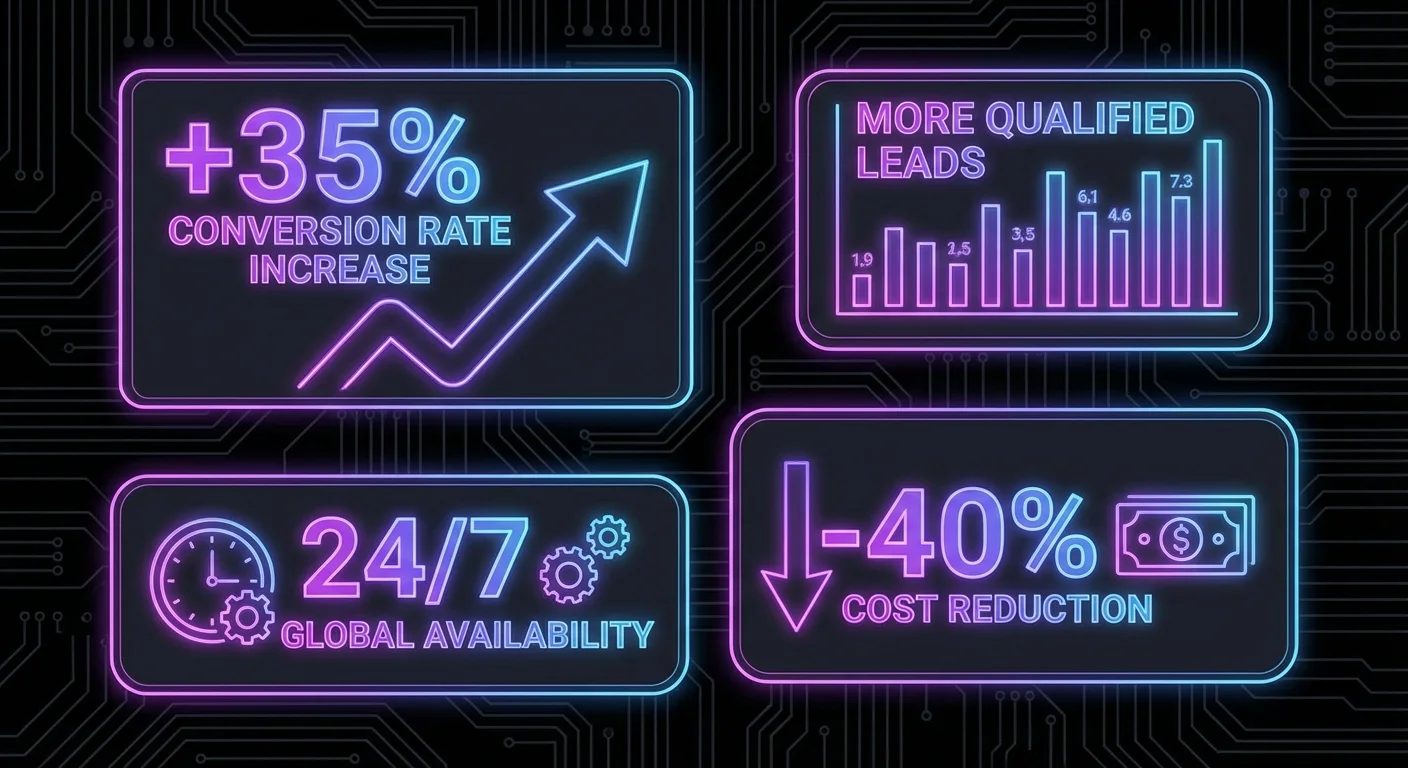
The data is clear: conversational lead capture beats static forms across every metric. Here is why.
Higher Conversion Rates
Static landing page forms convert at 2-5% on average. Lead generation chatbots consistently achieve 15-40% conversion rates. Conversational Design, a marketing agency, documented 40%+ conversion rates using chatbot-based lead capture -- compared to their previous 2.35% with traditional forms.
Lower Cost Per Lead
When your conversion rate jumps 5-10x, your cost per lead drops proportionally. Animal Equality reduced their blended CPL to just 2.33 euros using a WhatsApp chatbot for lead generation. That is significantly cheaper than traditional paid acquisition channels.
Better Lead Quality
A form captures whatever the visitor types. A chatbot can ask follow-up questions, validate answers, and score leads in real time. Your sales team receives pre-qualified leads with context instead of a list of email addresses with zero information about intent or fit.
24/7 Availability
According to a Dashly study, 64% of consumers say 24/7 availability is the best feature of chatbots. Your lead gen chatbot works nights, weekends, and holidays. For businesses serving international customers across time zones, this changes everything.
Reduced Friction
Every field you add to a form reduces conversions by roughly 11%. A chatbot collects the same information through conversation, one question at a time, making the process feel effortless.
7 Best Practices for Lead Generation Chatbots
1. Start with Value, Not Questions
Do not open with "What's your email?" Instead, offer something useful first: answer a question, provide a recommendation, or share a relevant insight. Value first, capture second.
Bad: "Hi! Enter your email to get started." Good: "Hi! I can help you find the right plan for your business. What's your main goal?"
2. Keep Conversations Short and Focused
The best lead gen chatbots ask 3-5 qualifying questions max. Every additional question increases drop-off. Get what you need for lead scoring, then hand off to a human or send a follow-up.
3. Use Conditional Logic (Branching)
Not every visitor is the same. Your chatbot should adapt based on answers:
- If budget > $10K: route to enterprise sales immediately
- If timeline is "just researching": offer a helpful guide and capture email
- If industry matches your ICP: prioritize and fast-track
This branching logic is what separates effective lead gen chatbots from glorified forms.
4. Personalize Based on Context
Use available data to personalize the conversation:
- Referral source: "I see you came from our comparison article. Looking to switch providers?"
- Page viewed: "Interested in our pricing? Let me help you find the right plan."
- Return visitor: "Welcome back! Last time you were looking at [product]. Any questions?"
5. Integrate with Your CRM and Sales Tools
A lead generation chatbot that does not connect to your CRM is a dead end. Ensure captured leads automatically flow into:
- Your CRM (HubSpot, Salesforce, Pipedrive)
- Email automation tools (Mailchimp, ActiveCampaign)
- Team notifications (Slack, email alerts)
- Calendar booking (Calendly, Cal.com)
6. A/B Test Your Chatbot Conversations
Test different:
- Opening messages (proactive vs. passive)
- Question sequences
- Qualification criteria
- CTA wording
- Timing of the chatbot trigger
Small changes in wording can yield 20-30% improvements in conversion rate.
7. Combine AI with Human Handoff
The best approach is not fully automated or fully human. It is a hybrid:
- AI chatbot handles initial engagement and qualification (scalable, instant)
- Human agent takes over for complex questions or high-value leads (empathetic, flexible)
- Seamless handoff with full conversation context
This hybrid model gives you the best of both worlds: the speed and scale of AI with the trust and nuance of human interaction.
Chatbot Lead Generation ROI: Real Numbers
Let us look at concrete numbers from real companies using chatbot lead generation.
Conversion Rate Improvements
- Conversational Design: 40%+ conversion rate (up from 2.35% with forms) -- source
- Drift customers: Average 10-15% increase in pipeline generation -- source
- Industry average: Chatbots generate 35-40% response rates vs. 2-5% for email -- source
Cost Savings
- Customer service automation: Chatbots can save up to $8 billion per year across industries by 2026
- Cost per lead reduction: Companies report 50-200% CPL reduction when switching from forms to chatbots
- Agent time saved: Lead qualification chatbots free up 30-50% of sales team time for closing instead of qualifying
Revenue Impact
- Speed-to-lead: Companies responding within 5 minutes are 21x more likely to qualify a lead. Chatbots respond instantly.
- Lead volume: Businesses using chatbots for lead gen report 2-3x more leads captured per month
- Pipeline velocity: Pre-qualified leads from chatbots close 20-30% faster than form-submitted leads
Types of Lead Generation Chatbots
Not all lead gen chatbots are built the same. Here are the main categories.
Rule-Based Chatbots
These follow a predefined decision tree. Visitors click buttons or choose from options. They are simple to build, predictable, and work well for straightforward qualification flows.
Best for: Simple lead capture, appointment booking, basic qualification.
AI-Powered Chatbots
These use natural language processing (NLP) and large language models (LLMs) to understand free-text input and respond intelligently. They can handle unexpected questions, provide nuanced answers, and create a more natural conversation experience.
Best for: Complex products, consultative sales, high-value leads that need more engagement.
Hybrid Chatbots
The most effective approach combines both: structured qualification flows with AI fallback for unexpected questions. The chatbot follows a script for core qualification but can handle tangential questions without breaking the flow.
Best for: Most businesses. You get the reliability of rules with the flexibility of AI.
Messaging-First Chatbots
A category most articles overlook entirely. Instead of living on your website, these chatbots operate on messaging platforms like Telegram, WhatsApp, or Instagram DMs. They meet your audience where they already spend their time.
Best for: Solopreneurs, coaches, freelancers, and businesses whose audience lives on messaging apps rather than browsing websites.
Best Channels for Chatbot Lead Generation
Website Chat Widgets
The most common deployment. A chat bubble on your website that engages visitors. Tools like Intercom, Drift, and Tidio dominate this space, but they come with enterprise pricing ($39-$2,500/month).
WhatsApp Business
With 2+ billion users globally, WhatsApp is the most popular messaging platform in the world. WhatsApp chatbots are particularly effective for:
- Local businesses in Europe, Latin America, and Asia
- Service-based businesses (coaches, consultants, real estate)
- E-commerce with high-touch sales processes
Telegram
Telegram's bot API is one of the most powerful and flexible available. Benefits include:
- No per-message fees (unlike WhatsApp Business API)
- Rich media support (buttons, menus, inline keyboards)
- No approval process for bot deployment
- Growing user base (900M+ monthly active users)
For solopreneurs and small businesses, Telegram offers the best balance of power and accessibility.
Instagram and Facebook Messenger
Great for D2C brands and businesses with strong social media presence. Tools like ManyChat specialize in this channel, offering automated DM flows for lead capture.
SMS
High open rates (98%) but higher costs. Best for time-sensitive offers and appointment reminders.
How to Set Up a Lead Generation Chatbot in 60 Seconds
Most chatbot platforms require days or weeks of setup: designing flows, connecting APIs, training AI models, configuring webhooks. That complexity keeps small businesses from adopting chatbot lead generation.
There is a simpler approach.
ClawRapid lets you deploy a fully personalized AI chatbot on Telegram in under 60 seconds. Here is how it works:
- Tell us about your business -- your niche, your services, your target audience
- We configure your AI assistant -- personalized for your industry with lead capture built in
- Deploy instantly -- your chatbot is live on Telegram, ready to engage and qualify leads
No coding required. No flow builder. No API configuration. Your chatbot comes pre-trained for your specific business niche, whether you are a real estate agent, a fitness coach, a freelance consultant, or a digital marketing agency.
At $45/month, it is a fraction of what enterprise tools like Drift ($2,500/month) or Intercom ($39/seat/month) charge. And unlike DIY solutions that require technical skills and ongoing maintenance, ClawRapid handles all the infrastructure, updates, and optimization for you.
Common Mistakes to Avoid
Asking Too Many Questions
Every question is a potential drop-off point. If your chatbot asks 10 qualifying questions before collecting an email, you will lose most visitors. Stick to 3-5 essential questions.
Being Too Pushy
Chatbots that immediately demand contact information feel like spam. Build rapport first. Provide value. Then ask.
Ignoring Mobile Users
Over 60% of web traffic is mobile. If your chatbot widget covers the entire mobile screen or is difficult to interact with on a phone, you are losing leads. Test on mobile devices.
No Human Handoff Option
Some questions require a human. If your chatbot cannot escalate to a live agent (or at least collect details for a callback), frustrated visitors will leave. Always provide an exit ramp to a real person.
Not Tracking and Optimizing
Set up analytics from day one. Track:
- Conversation start rate
- Completion rate (how many finish the qualification flow)
- Lead quality score distribution
- Conversion to customer rate
Without data, you cannot improve.
FAQ
How much does a lead generation chatbot cost?
Pricing varies widely. Enterprise solutions like Drift start at $2,500/month. Mid-market tools like Tidio or Intercom range from $29-$100/month. For solopreneurs and small businesses, managed solutions like ClawRapid start at $45/month ($15 AI credit included).
Can chatbots really replace lead capture forms?
Not entirely, but they can dramatically improve them. The best approach is to offer both: a chatbot for visitors who prefer conversation, and a simple form for those who prefer to self-serve. In practice, chatbots capture 3-10x more leads than forms alone.
What is the best platform for a lead generation chatbot?
It depends on where your audience is. For website visitors, tools like Intercom or Tidio work well. For messaging-first audiences, Telegram and WhatsApp chatbots (like those deployed via ClawRapid) are more effective because they meet people where they already spend time.
How long does it take to set up a lead gen chatbot?
Enterprise platforms can take weeks to configure properly. No-code builders like Landbot or ManyChat take hours. Managed solutions like ClawRapid deploy in under 60 seconds because the AI is pre-configured for your business niche.
Do chatbots work for B2B lead generation?
Absolutely. B2B chatbots are particularly effective because the qualification process is well-defined (budget, authority, need, timeline). A chatbot can ask BANT questions naturally and route qualified leads to your sales team instantly.
What conversion rate can I expect from a lead generation chatbot?
Results vary by industry and implementation, but most businesses see 10-40% conversion rates from chatbot interactions, compared to 2-5% from traditional forms. The key factors are conversation design, timing, and relevance.
Bottom Line
Chatbot lead generation is not a future trend. It is a proven strategy that businesses of every size are using right now to capture more leads, qualify them faster, and reduce acquisition costs.
The data speaks for itself: chatbots deliver 5-10x higher conversion rates, reduce cost per lead by 50-200%, and work around the clock without breaks, vacations, or sick days.
Whether you choose an enterprise platform, a DIY builder, or a managed solution, the important thing is to start. Every day without a lead generation chatbot is a day you are leaving leads on the table.
If you want the fastest path to a working lead gen chatbot, try ClawRapid. Deploy in 60 seconds, no technical skills required, and start capturing leads today.
Which agent do you want to deploy?
The battle-tested assistant, extensible with 16,000+ skills.
Which model do you want as default?
Low token prices with Max reasoning. You can also connect a ChatGPT subscription that includes this model.
You can switch anytime from your dashboard
Which channel do you want to use?
You can switch anytime from your dashboard
In 60 seconds, your AI agent is live.
Related articles
AI Customer Service Bot: What It Is, How It Works, and When You Need One
A clear explanation of AI customer service bots: what they do, how they work, where they fail, and how to decide whether your business needs one.
How to Automate Customer Service with AI in 2026
A practical playbook for automating customer service with AI. Learn what to automate first, how to roll it out, and which metrics to track.
Automate Your Prospecting in 2026: Complete Guide for Entrepreneurs
Discover how to automate your sales prospecting with AI, chatbots, and multichannel tools. Practical guide with strategies, tools, and FAQ.